ankh_hpl: (Default)
sisters from the stars
our refugee status
automatic


-- Ann K. Schwader

https://www.internationalwomensday.com/
ankh_hpl: (Default)
So who needs dragons when you can hatch a pterodactyl?

Jennifer Mandula's The Geomagician is a richly imagined, solidly researched historical fantasy with both heart and brains. Set in an alternate Victorian England, it features a fictional version of the very real Mary Anning, a humble but self-educated fossil collector and paleontologist. Fossils, it turns out, make excellent storage vessels -- reliqs -- for personal magic, which everyone has to some extent. Unfortunately, the poor often have no choice but to sell their magic to survive. Significant portions of England's Industrial Revolution are fueled by this . . . which, of course, has inspired radical reformers.

Mary steps into the thick of it after she lets the Geomagical Society of London know about her newly hatched pterodactyl, Alex. Toothy, cute, and possibly imprinted on her, the critter may be her ticket to membership in the Society (despite her inconvenient gender). Or it may trigger a series of other adventures -- bringing her to the attention of the Church of England's Inquisitors in the process. And reuniting her with the lost love of her girlhood, who has scientific / political ambitions of his own.

When Mary comes to London (with Alex) the plot shifts into high gear. There's a secret lurking at the heart of the Society she wants so much to join -- and a radical reformer or two among her friends. At every turn, Mary faces questions of loyalty. Does she advance her own ambitions, or support other women? Does she side with her lost love, or her conservative mentor?

There's a lot going on in this novel. Adding magic to a society in the throes of science-based change doesn't simplify anything -- but that's part of the fun. The more the reader knows about Mary Anning and her times, the more enjoyable the read is likely to be. ( Even a quick Wikipedia check enhanced my time with this book.) Recommended for urban fantasy enthusiasts looking for something chewy and different, or anyone fascinated by paleontology.

My thanks to NetGalley for providing me with ARC in exchange for an honest review.
ankh_hpl: (Default)
My new Lovecraftian sonnet "Yuggoth at the Rim" leads off the TOC this time in Spectral Realms No. 24 (Winter 2026). Edited by S.T. Joshi., this venerable journal of weird verse and reviews offers 135 pages of new work by the Usual Suspects & many newer poets in the field, plus two Classic Reprints, one article devoted to Clark Ashton Smith, and two reviews. Perfect-bound with color cover.

For full TOC, or to order:

https://tinyurl.com/3wk49nyr
ankh_hpl: (Default)
This chapbook collection from LindaAnn LoSchiavo features a remarkable variety of takes on the European vampire, in nearly as many verse forms. Though comfortable with free verse, LoSchiavo demonstrates her unforced skill with the prose poem, fibonacci ( and other syllabic patterns), villanelle, sonnet, golden shovel, and possibly others. The overarching feel, however, is not merely crafts(wo)manship. It is pure Gothic entertainment, with a wide streak of dark humor.

Enhanced by several full-page black and white illustrations-- also humorous -- by Giulia Massarin and Erin Caldwell, the poems shift between historical times and present day, with Dracula himself (or some analogue) frequently present in full evening dress. He pops up in the Playboy Club, near a hangman's tree in Poland, in a series of texts discovered after a disappearance from a college dorm. Other interactions with modern-day vampirism include an Italian sonnet describing an unsatisfying movie rental, and an online offer to train aspiring bloodsuckers with a prepaid master class.

Bram Stoker is given his own briefer section, with several poems focused on the novel itself. Quotes from Dracula and other appropriate texts add to the atmosphere.

Recommended for Gothic/vampire enthusiasts in search of a lighter touch, and any spec poetry reader unafraid of surefooted formalism. My thanks to NetGalley and Twisted Dreams Press for providing me with this ARC.
ankh_hpl: (Default)
Do Androids Dream of Electric Sheep?Do Androids Dream of Electric Sheep? by Philip K. Dick

My rating: 3 of 5 stars


I chose to listen to this because I'm a multiple viewer of the movie Bladerunner. I've really enjoyed each viewing (though wasn't at all happy with its sequel), & I figured it was time to try the book. Unfortunately, the book has much less in common with Bladerunner than I'd expected. The movie is a generally well-paced, SF noir adventure. The book . . . is not.

I'd never read/listened to a full-length Philip K. Dick book before, so I suspect I wasn't prepared for his style. What I wound up experiencing was a slow-paced look at Decker's work as an android bounty hunter, his home life, & his relationship with an electronic religion which seems to provide minimal hope in a post-WW III world. The book felt like a very dated future, & the plot meandered a great deal. I did, however, find out about the electric sheep!

I'm not sure who I would recommend this to, but I'm glad to have finally experienced a Philip K. Dick novel. YMMV, definitely.


View all my reviews
ankh_hpl: (Default)
BurnBurn by Peter Heller

My rating: 4 of 5 stars


This is a beautifully written & (at points) heartbreaking book, but not what I was expecting -- & frankly, not what I'd concluded from other reviews. I have seen this discussed as a thriller with dystopian overtones. There is some of that, but the overall vibe is mainstream with more concern for lyrical prose than for action -- or, indeed, for a fully realized ending.

The general plotline (no spoilers!) involves two lifelong friends on a fall hunting trip in Maine, who find themselves trapped in an increasingly perilous military/political situation. While watching them try to get themselves clear of this, we learn a great deal about their pasts, their friendship, & their complicated family situations, along with a few moments of shocking violence. (Warning for readers like me: something bad happens to a dog, too late to quit reading.) There is wilderness survival, gorgeous nature writing, & some extremely relevant observations about our country's problems. However, at the end, the reader is left with more loose ends than I felt completely comfortable with.

I suspect I was not the ideal reader for this one, though I did appreciate the writing & was genuinely moved by the ending, incomplete though it was. YMMV, definitely.


View all my reviews
ankh_hpl: (Default)
The Glowing HoursThe Glowing Hours by Leila Siddiqui

My rating: 4 of 5 stars


Although loosely based upon the infamous Year Without a Summer of 1816, when Mary Shelley began her groundbreaking Frankenstein, Leila Siddiqui's dark tale is less historical fiction about Gothic writers than a full-on Gothic novel all its own. Taking its title from Byron's "Childe Harold's Pilgrimage," it quickly disabuses the reader of any romantic notions about those Glowing Hours. Instead, thanks to the outsider viewpoint of the Shelleys' Indian housemaid -- a gently born Muslim heiress cast adrift in England -- the whole Shelley/Byron/Polidori dysfunction is on full display.

After a framing Prologue (chronologically an Epilogue set in 1858), Mehrunissa Begum (Mehr) begins her journey from protected resident of her uncle's household to struggling domestic servant. Soon enough, she finds herself hired by Mary Shelley and her (possible) husband Percy. Together with their infant son and Mary's half sister Claire Clairmont, they are soon off to Europe to meet with the famous poet Lord Byron.

Anyone familiar with the Romantic poets already knows this is not going to end well. Invited to stay in Byron's rented villa after their own modest cottage begins leaking from the incessant rains, the Shelleys and Mehr find themselves trapped -- literally -- by a house not so much haunted as obsessed.

As Mehr struggles to fulfill her duties, befriend Mary, and keep clear of Byron, events take on a nightmarish cast. Mehr find an unexpected ally in Polidori, Byron's young physician, but neither of them can forestall the full Gothic menu of terrors. Denied inheritances, revenants, scandalous loves, family secrets, and murders -- they're all here, woven through a plotline which sometimes struggles a little to wind up believably. There's a full measure of satisfaction when it does, though.

Readers expecting a strictly historical approach are likely to be disappointed by The Glowing Hours, but those who appreciate mystery, dread, and revisionist approaches will likely lose themselves in these pages. My thanks to NetGalley for providing me with an advance copy in exchange for an honest review.


View all my reviews
ankh_hpl: (Default)
The MaidensThe Maidens by Alex Michaelides

My rating: 4 of 5 stars


I've seen this mentioned as Dark Academia in various places, but I didn't find it to qualify as such. What it is, however, is an extremely well-crafted literary mystery set in Cambridge. There are many references to ancient Greece & mystery cults, but nothing overtly supernatural going on. The main POV character is an intelligent, likeable, & competent woman (psychologist), & she is supported by others. The general vibe reminded me of P.D. James.

I listened to this on Audible, & found the performance added a lot. Definitely worth a full credit purchase.


View all my reviews
ankh_hpl: (Default)
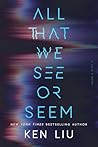
Testimony of Mute Things (Penric and Desdemona #15)Testimony of Mute Things by Lois McMaster Bujold
My rating: 5 of 5 stars


Any new Penric novella is a treat for Bujold fans, but this one may be particularly welcome -- at least, to those of us who have longed for a bit more action / intrigue than her more recent family-oriented offerings have had. (Those are excellent, too, of course -- but in different ways.) Set between the action of Penric's Fox & Masquerade In Lodi, this adventure revolves around a murder case during a difficult Temple conclave.

Young Penric is attending as an assistant to his superior, Princess-Archdivine Llewen of Martensbridge. He's expecting a mundane, even dull few days -- but when he becomes entangled in the bizarre murder of a corrupt Temple official, it will take all his & his demon Desdemona's skills to find the solution. This one offers a deep dive into Bujold's Five Gods magic system, as well as plenty of focus on Desdemona herself.

As with most of the Penric novellas, it's best to begin at the beginning of the series. Testimony is decidedly not for first-timers, & relies at least a little on the reader's familiarity with past adventures. At 151 pp, it is also good value for a novella.


View all my reviews
ankh_hpl: (Default)
All That We See or Seem (Julia Z, #1)All That We See or Seem by Ken Liu

My rating: 4 of 5 stars


Ken Liu's All That We See Or Seem is a near future thriller with a side order of cyberpunk and an inner core of self-discovery. Although the book isn't short -- a bit over 400 pages --- it packs a lot into that space. Not all the plot threads tie off neatly, but the pacing seldom flags.

As with most thrillers, too much plot summary produces Spoiler. In essence, then, the novel follows Julia Z., an "orphan hacker" who became notorious by age fourteen in a scandalous criminal case. After building herself a new reclusive existence in Boston, she is located and recruited by a desperate husband trying to locate his missing wife. He believes she's been kidnapped -- and because she's a well-known onierofex (dream artist, one of the further-out ideas in this book), he suspects one of her private clients may be behind it.

Things get dangerous quickly, because that private client turns out to be an international crime boss with an obsessive streak. After one early warning-off (involving the death of a pet, readers like me be aware), Julia and the husband go on the run just in time. Their attempt to locate the missing onierofex becomes a series of puzzles and close calls, with Julia's small arsenal of portable tech barely keeping them ahead of their enemies.

At about the halfway point of the novel, however, the rescue plot becomes one of calculated revenge. After years of strict self-reliance, Julia is forced to call upon allies from her past -- and others made along the way -- in order to continue, or indeed to survive. This second half also reveals just how day-after-tomorrow the novel's world is. There are sideways references to several recent political / social concerns, and a grim (though believable) view of the future of social media.

This is apparently the first in a new series for Liu. Although I had a few quibbles with this book, and particularly with the Epilogue, I'm already waiting for Julia Z.'s next adventure. All That We See Or Seem is an SF thriller with both brains and heart, with plenty to think about after finishing. Thanks to NetGalley for supplying me with an advance copy in exchange for an honest review.


View all my reviews
ankh_hpl: (Default)
Book and Dagger: How Scholars and Librarians Became the Unlikely Spies of World War IIBook and Dagger: How Scholars and Librarians Became the Unlikely Spies of World War II by Elyse Graham

My rating: 4 of 5 stars


A solid and very recent history of what academics & related folk did to further the cause of Allied victory in WW II -- mostly focused on America's contribution. As a former academic myself, I was cheered to learn how much research, close reading, & sheer shoveling of paper can do for military intelligence! For those familiar with the Monuments Men, there was also a good bit about museums & art recovery.

The writing is clear and entertaining, and the Audible version was easy to listen to. It should be noted that this book does have some subtext commentary about current events / intelligence situations in the U.S. All readers may not appreciate this, though I had no problem with it. YMMV, as ever.


View all my reviews
ankh_hpl: (Default)
I have a cosmic horror sonnet, "Dark Comets," in this sixth issue of "A Journal of Weird Fiction & Criticism" from Hippocampus Press. Edited by S.T. Joshi, with full color cover by Daniel V. Sauer, this perfect-bound issue offers over 250 pp. of fiction, criticism, poetry, & reviews.

For TOC, or to order:

https://www.hippocampuspress.com/journals/penumbra/penumbra-no.-6-autumn-2025?zenid=kn2e193u4kkur439utbft33kt6
ankh_hpl: (Default)
I've got a dark Greek mythology sonnet, "Iphigenia, After," in the twelfth annual Horror Writers Association Poetry Showcase. Edited by Maxwell I. Gold, with full color cover art by Daniel V. Sauer. This yearly showcase offers previously unpublished work by HWA members, and is available from Amazon in both e-book and hard copy formats.

Paperback: https://tinyurl.com/4uyzttjk
E-book: https://tinyurl.com/ms89ns2d
ankh_hpl: (Default)
Howl: An Anthology of Werewolves from Women-in-HorrorHowl: An Anthology of Werewolves from Women-in-Horror by Stephanie M. Wytovich

My rating: 4 of 5 stars


This generously-sized (22 stories and poems) anthology bills itself only as "an anthology of werewolves" from Women In Horror. However, as the Introduction makes clear, this is an anthology of werewolves used to examine women's mostly contemporary concerns. Women's power, its loss and regaining, is probably the most frequent theme. Relationships between women, either in families or friendship groups, also come in for close examination. Family secrets about women are exposed in the full glare of moonlight. And always, in the face of abuse or worse, there is vengeance.

This anthology is divided into moon-phase sections, New Moon through Waning. This places the stories in rough groupings, though I was unable to figure out why some stories were placed where they were. The New Moon tales have a somewhat mythic or fairy tale feel to them, exemplified by Donna Lynch's "Silver Boots." Waxing Moon stories mostly involve friendships or sisterhood, with a couple of standouts (for me) in this section being Erika T. Wurth's "When He Could Have Me" and Gwendolyn Kiste's post-apocalyptic "Our Howls Like Dirges, Our Eyes Like the Moon." The Full Moon tales involve lycanthropy as empowerment or coming of age. Some of these stories seemed a bit vague to me, but I particularly enjoyed Christina Henry's "When We Run We are Free" -- a frankly feel-good rescue/vengeance plot with bits of werewolf culture thrown in.

The final section, Waning, addresses such contemporary concerns as bodily autonomy, racial identity, and the ability of powerful men to get away with serial abuse. Examples here include Alexandrea Weis' "Dark Justice," with a Louisianan loup-garou running a battered women's shelter, and Wendy N. Wagner's "The Wolf Line" with its action-packed road trip from Idaho to Oregon, a sympathetic werewolf driving a fifteen-year-old with a too-adult problem and bounty hunters on their tail. There is also another bit of SF -- Katrina Monroe's "Super Moon" -- and the prose poem "13 Times I Swallowed a Full Moon" by Stephanie M. Wytovich.

As with all themed anthologies, not every story (or poem, with three well-crafted ones appearing here) will appeal to every reader. However, there's enough variety here to make it worthwhile for those who enjoy socially influenced dark fiction.

[My thanks to NetGalley for providing me with an ARC in exchange for an honest review.]


View all my reviews
ankh_hpl: (Default)
Baltimore
a child again
with Annabel Lee


-- Ann K. Schwader

https://en.wikipedia.org/wiki/Death_of_Edgar_Allan_Poe
ankh_hpl: (Default)
I have a new sonnet -- "Wind Phone Callback" -- in the twenty-third issue of Hippocampus Press's semiannual journal of weird verse and reviews. Edited by S.T. Joshi , 131 pp. perfect-bound trade paperback with color cover by Dan Sauer.
As usual, this issue offers a wide selection of practitioners and poetry styles, including both formalists and free-verse poets plus a good shot or two of prose poetry. There are also two reviews, both by editor Joshi, and two Classic Reprints.

For more information, TOC, or to order:

https://www.hippocampuspress.com/journals/spectral-realms/spectral-realms-no.-23
ankh_hpl: (Default)
The Adventure of the Demonic Ox (Penric and Desdemona, #14)The Adventure of the Demonic Ox by Lois McMaster Bujold

My rating: 4 of 5 stars


This Penric & Desdemona novella skews heavily towards domestic concerns rather than high adventure, though it does provide much new information about the religious /magic system in Bujolds's World of the Five Gods. The ox itself -- who actually is demonic, in the Five Gods sense -- provides a central point for a nerve-wracking family exerience. Most of the reader satisfaction here is likely to come from learning more about how Pen's family is growing up, & how the various demons (no spoiler, but there are now more!) associated with them are being trained.

Bujold does a good job of placing reminders about critical past events, but readers should not come to this one cold. Many plot points assume prior knowledge, or are at least more fun for those with prior knowledge.

Recommended immediately for anyone following this series, of course.


View all my reviews
ankh_hpl: (Default)
The Nazi Mind: Twelve Warnings from HistoryThe Nazi Mind: Twelve Warnings from History by Laurence Rees

My rating: 5 of 5 stars


A worthwhile & very timely listen, presenting the overall arc of the rise & fall of Nazi Germany through a psychological lens. A historian & filmmaker, Rees has decades of research experience on WW II & is the former head of BBC TV History programming -- all of which makes his style entertaining & easy to follow.

A lot of the information presented here is chilling, but Rees stays within his historical lines & does not veer into much current-day speculation. Recommended for anyone interested in historical patterns, WW II, or simply the workings of the human mind under stress.


View all my reviews
ankh_hpl: (Default)
Coffin MoonCoffin Moon by Keith Rosson

My rating: 3 of 5 stars


Vengeance takes a road trip in this historical (mid-1970s) vampire thriller with a side order of splatterpunk. Starting off in Portland, OR, the novel follows Duane Minor, a Vietnam vet coping with PTSD and temper issues. He's trying to make a go of life post-Nam with his wife Heidi, her parents, and her thirteen-year-old niece Julia. All he wants is to tend bar, stay sober, and make some sort of connection with Julia, who is living with them after her own mother shot her stepfather and got sentenced to life in prison.

Unfortunately -- at least partly due to Duane's temper -- this isn't going to happen. Instead, he gets crosswise with a vampire whose fuse is even shorter than his own. John Varley wasn't a nice guy before he got turned somewhere back in the Old West, and fangs haven't improved him. In the bloody chaos that follows, Duane manages to get Julia safely away from Portland. His niece, however, is determined to avenge everyone they've lost; and she'll do anything to accomplish this.

The rest of the novel follows Duane as he tries to keep Julia safe, John Varley as he tries to escape what he's done (not for the first time), and Julia herself as she works toward her vengeance. This makes for suspenseful reading, but also for a good bit of confusion as points of view shift and blend. The novel is solidly character-forward, but Rosson devotes nearly as much time to background as he does to keeping the plot flowing. Though his vampire mythology is well structured and violent, it doesn't offer much explanation past that absolutely required. A lot happens in this short (320 pp. in hard copy) novel, but I for one was left wondering why. Or, in the tradition of some bleak films of the era, if why was even a question worth asking.

Coffin Moon is a reliable thrill ride, recommended for vampire fans who prefer their sub-genre gritty and graphic. The ending may not completely satisfy, but it's true to the 1970s film feeling.

[My thanks to NetGalley and Random House for supplying me with an ARC in exchange for an honest review.


View all my reviews

March 2026

S M T W T F S
12 345 67
891011121314
15161718192021
22232425262728
293031    

Syndicate

RSS Atom

Style Credit

Expand Cut Tags

No cut tags
Page generated Mar. 24th, 2026 04:00 am
Powered by Dreamwidth Studios